 Study Sarthi
Govt. plans security protocol for fishing harbours under CISF oversight
Syllabus Relevance: GS-III (Internal Security; Security challenges and their management in border areas)
1. Key Development
-
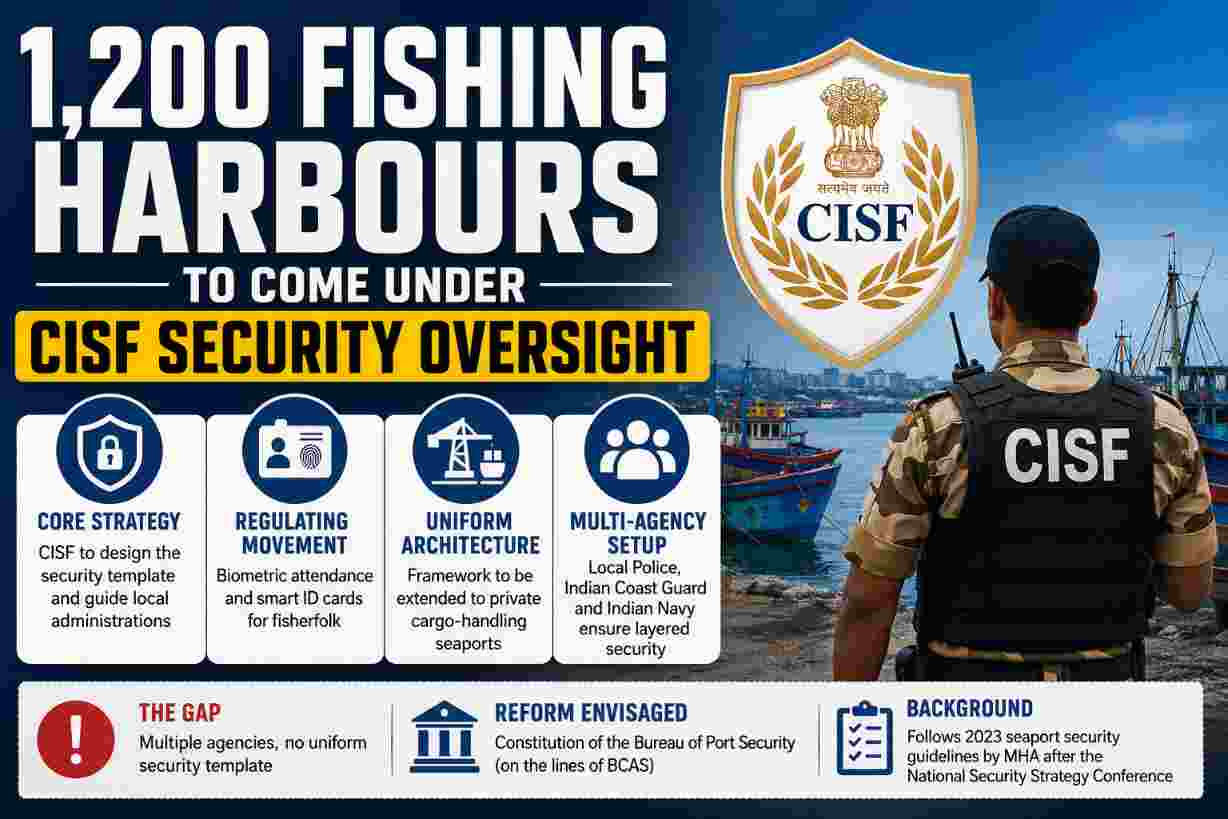
The Union Ministry of Home Affairs (MHA) plans to bring nearly 1,200 fishing harbours and fish landing sites under the security oversight of the Central Industrial Security Force (CISF).
-
This follows the prior designation of the CISF as the security regulator for over 250 seaports in the country.
2. Core Strategy & The CISF's Role
-
Security Regulator: Physical deployment at all sites is not possible; CISF will instead design the security template and guide local administrations in managing protocols.
-
Regulating Movement: Introducing a biometric attendance system and smart ID cards for fisherfolk.
-
Uniform Architecture: The government intends to deploy this "sovereign entity" framework at private cargo-handling seaports as well.
3. Current Administrative Setup
-
Total Hubs: There are 1,547 notified fish landing centres and fishing harbours across 13 coastal States and UTs.
-
Dual Governance:
-
States: Responsible for post-construction management, maintenance, and operation of harbours under their control.
-
Center: Harbours under Central control are managed by Port Trusts (under the Ministry of Fisheries).
-
-
Multiple Security Agencies: Deployment stretches from local police on land/shore, to the Indian Coast Guard, and the Indian Navy further out at sea.
4. Identified Gaps & Reforms Envisaged
-
The Gap: The involvement of multiple agencies has resulted in the absence of a uniform security template.
-
Bureau of Port Security: The MHA is planning the constitution of this dedicated body for the security of vessels and port facilities, modeled on the Bureau of Civil Aviation Security (BCAS).
-
Background Guidelines: This follows the seaport security guidelines issued by the Home Ministry in 2023 after deliberations at the National Security Strategy Conference.