14 May 2026
In a significant legal development before the Supreme Court, the Central Government has argued for a broader interpretation of religious freedom under the Indian Constitution. This case is crucial for students of Indian Polity and Constitutional Law, as it challenges decades of judicial precedent regarding how the state interacts with religious customs.
The Core Argument
The Solicitor General, representing the Centre, presented several key arguments before a nine-judge Bench:
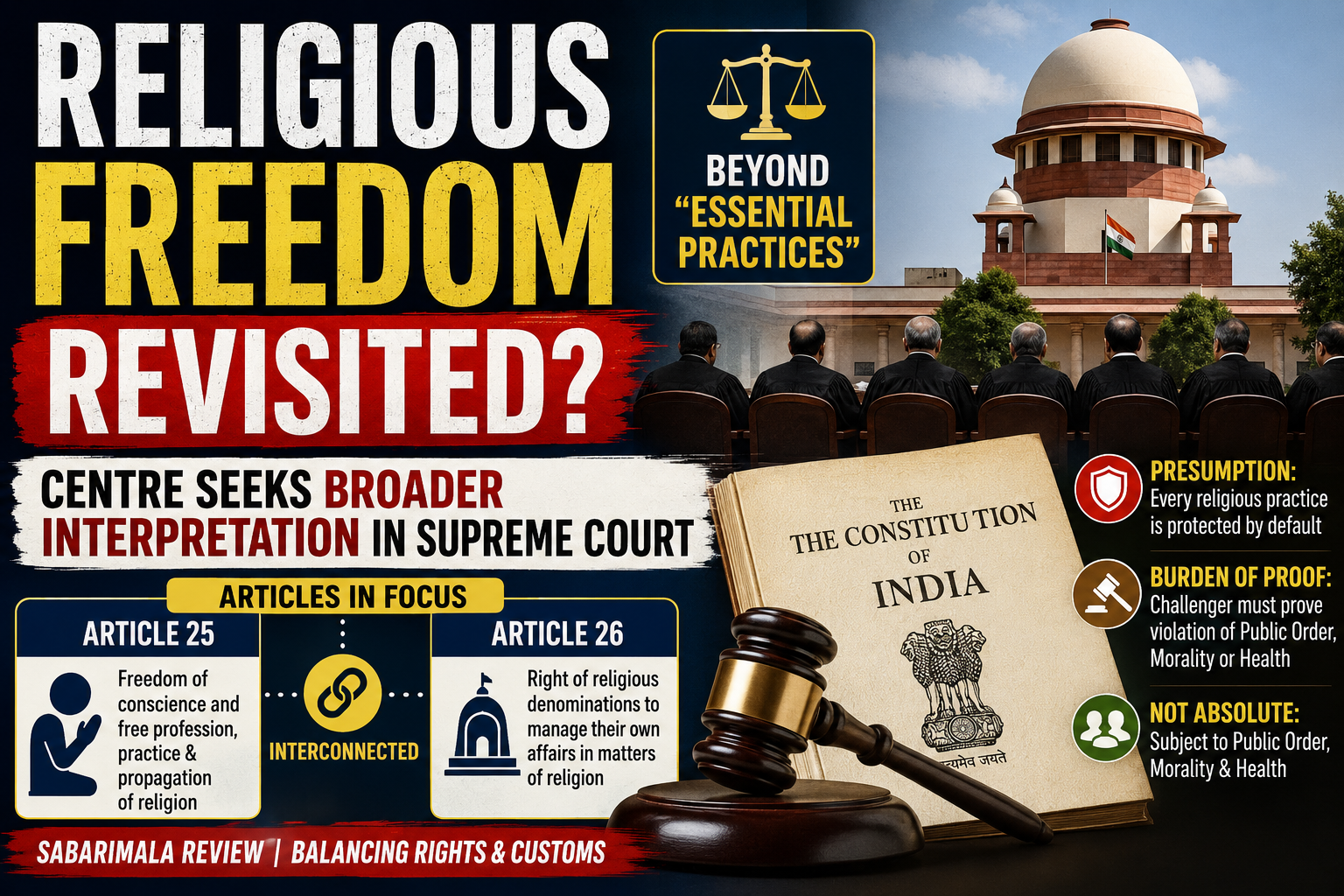
Beyond "Essential Practices": The Centre argued that constitutional protection for religion is not limited only to "essential religious practices" but has a much wider scope.
Presumption of Protection: The Constitution presumes every religious practice is protected by default.
Burden of Proof: The burden lies on the person challenging a practice to prove that it violates public order, morality, or health.
Judicial Creativity: The Centre pointed out that the phrase "essential religious practices" does not actually appear in the text of the Constitution and is a product of previous court rulings.
Constitutional Articles in Focus
The hearing centers on the relationship between two specific articles:
Article
Purpose
Article 25
Protects an individual's right to freedom of conscience and the right to freely profess, practice, and propagate religion.
Article 26
Grants religious denominations the right to manage their own affairs in matters of religion.
The "Interconnected" Argument: The Solicitor General submitted that these articles are not "isolated silos". Instead, Article 26 is seen as a collective manifestation of the individual rights guaranteed under Article 25.
Context: The Sabarimala Review
This hearing is part of a larger constitutional reference arising from the Sabarimala review petitions. The court is currently examining how to balance individual fundamental rights (like equality) with the collective rights of religious denominations to follow their traditional customs.
Key Takeaways for Students
Expanding Rights: Traditionally, the Supreme Court used the "Essential Religious Practices" test to decide which rituals were protected. The Centre is now pushing for an expansive interpretation, similar to how other fundamental rights (like the Right to Privacy) have been broadened over time.
Three Grounds of Restriction: Even with a wider ambit, religious freedom is not absolute. It remains subject to three specific constitutional hurdles: Public Order, Morality, and Health.
Judicial Review: This case highlights the tension between "judicial creativity" (the court creating its own tests) and the literal text of the Constitution.
 Study Sarthi