 Study Sarthi
India bans Sugar Exports till Sept 30
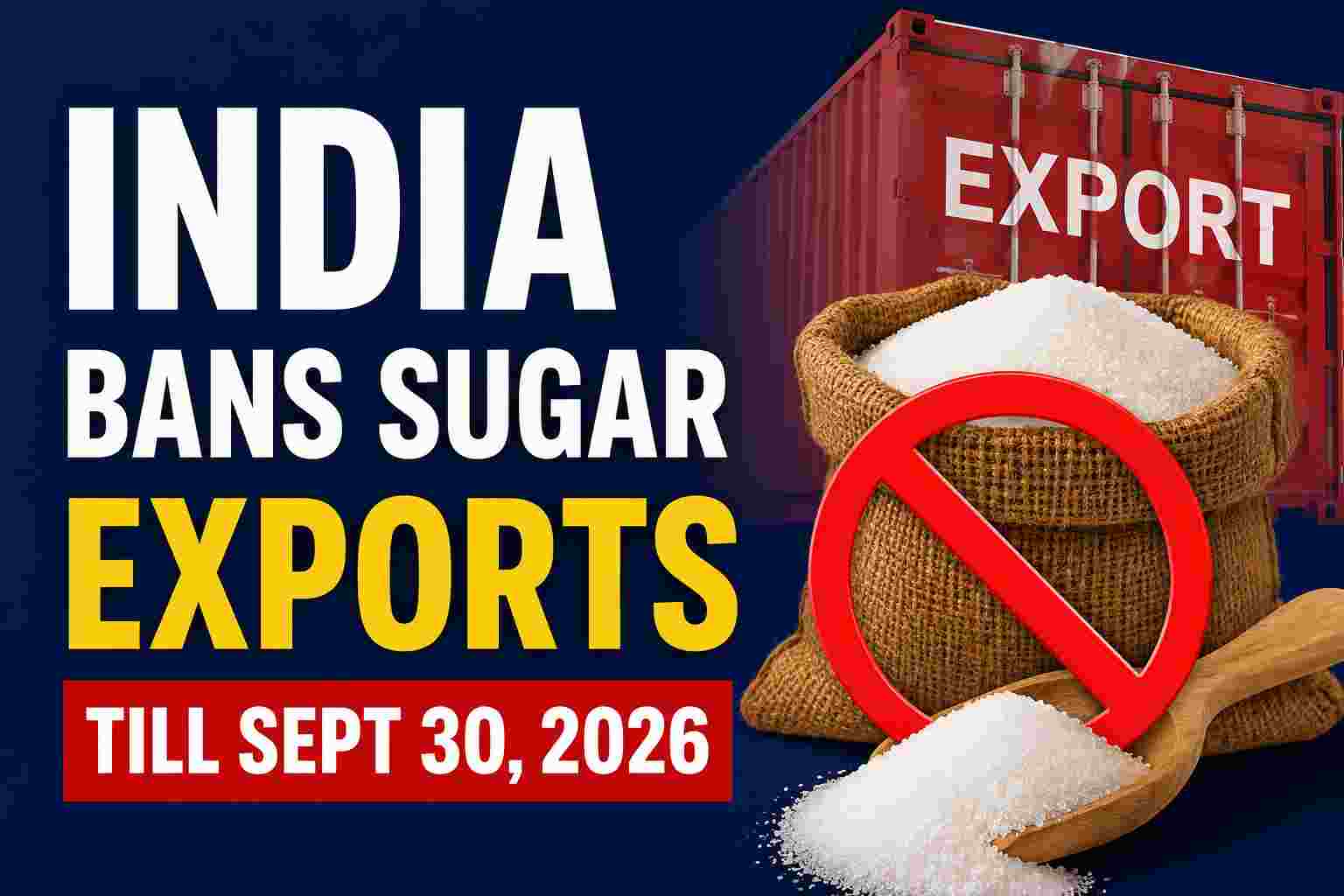
India has tightened sugar export rules by moving sugar from the “restricted” category to the “prohibited” category for exports until September 30, 2026. This means exporters generally cannot ship sugar abroad without special exemptions.
Key points from the notification
-
Export of raw, white, and refined sugar is banned.
-
The restriction will remain in force till 30 September 2026.
-
Some exceptions remain:
-
Exports to the United States and European Union under quota systems (CXL and TRQ)
-
Exports under the Advance Authorisation Scheme
-
Government-to-government export deals
-
Shipments already in process before the notification
-
Why did the government take this step?
The main reason is concern over lower-than-expected sugar production in the current 2025–26 sugar season.
The Indian Sugar and Bio-energy Manufacturers Association (ISMA) had earlier estimated:
-
Total sugar production: 324 lakh tonnes
-
Sugar diverted for ethanol: 31 lakh tonnes
-
Net sugar production: 293 lakh tonnes
However, production later weakened in major sugar-producing states like:
-
Maharashtra
-
Uttar Pradesh
This reduced the overall output outlook.
What does this mean for India?
The decision is mainly aimed at:
-
Protecting domestic sugar availability
-
Preventing price spikes in the local market
-
Ensuring enough sugar supply for both consumers and ethanol blending programs
India has increasingly been diverting sugarcane toward ethanol production as part of its fuel blending strategy, which also affects sugar availability.
Possible impact
-
Domestic sugar prices may remain more stable.
-
Global sugar supply could tighten slightly because India is one of the world’s largest sugar exporters.
-
Sugar mills may face reduced export opportunities, though ethanol production still offers revenue support.