 Study Sarthi
MSP Hike for Kharif Crops (2026-27)
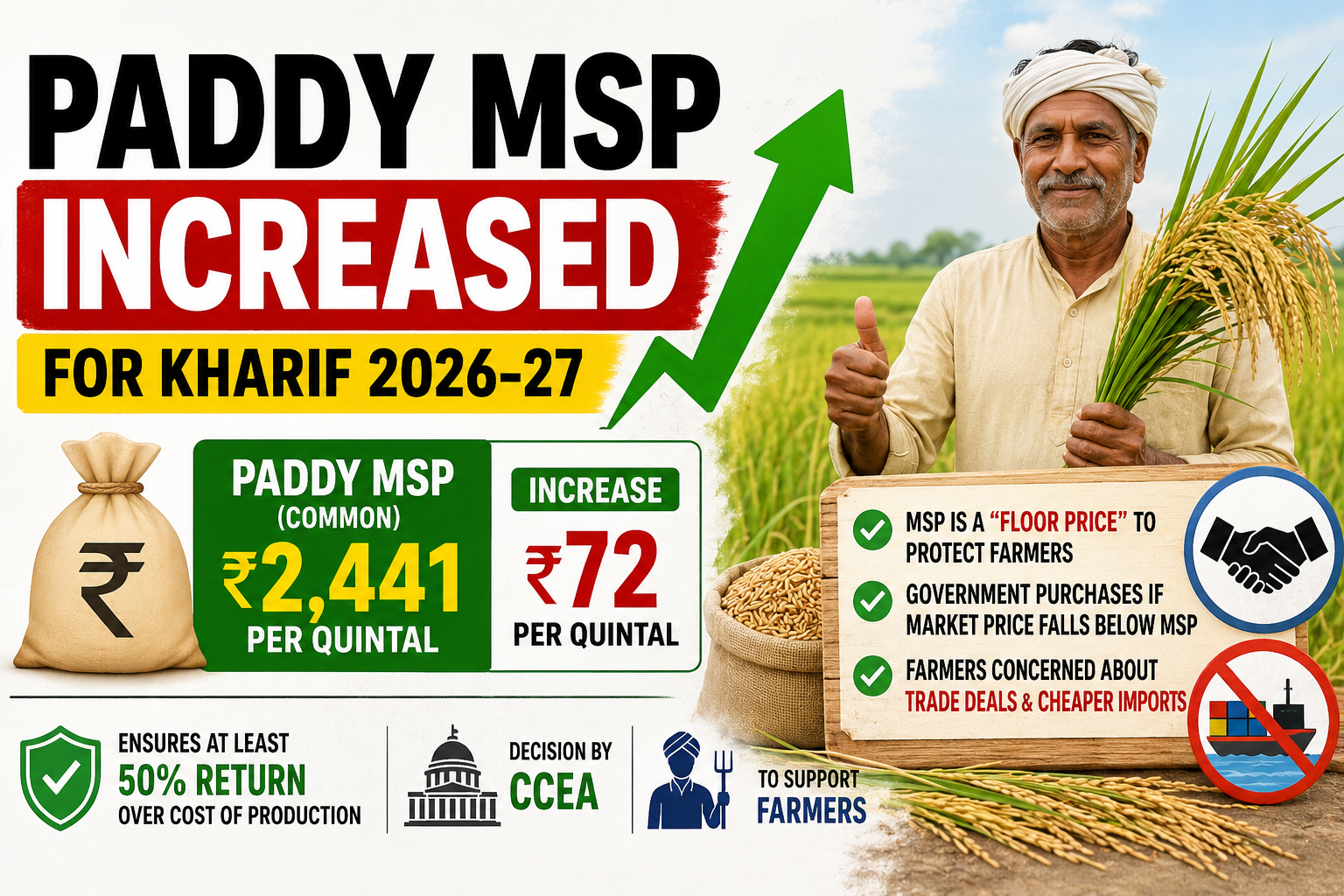
The Cabinet Committee on Economic Affairs (CCEA) has officially announced an increase in the Minimum Support Price (MSP) for Kharif crops for the 2026-27 marketing season.
Key Highlights of the Announcement
-
Paddy MSP Increase: The MSP for 'Common' variety paddy has been increased by ₹72 per quintal, bringing the new rate to ₹2,441.
-
A-Grade Paddy: The revised MSP for the A-grade variety of paddy is now ₹2,461 per quintal.
-
Profit Margin Goal: Union Minister Ashwini Vaishnaw stated that these revised rates are designed to ensure farmers receive a return of at least 50% over the cost of production for each crop.
Understanding the Concept: What is MSP?
-
Definition: MSP is a "floor price" set by the government to protect farmers against any sharp fall in farm prices during bumper production years.
-
Mechanism: If the market price falls below the MSP, government agencies purchase the produce from farmers at the announced rate.
-
Kharif vs. Rabi:
-
Kharif Crops: Sown at the beginning of the monsoon (e.g., Paddy, Maize, Bajra).
-
Rabi Crops: Sown in winter (e.g., Wheat, Mustard).
-
The Current Controversy: Trade Deals & MSP
Despite the hike, several farmer organizations have expressed dissatisfaction. Their primary concerns include:
-
Inadequate Buffering: Groups argue the hike does not sufficiently account for rising input costs.
-
Trade Deal Impact: There is significant concern regarding the India-U.S. trade deal and other Free Trade Agreements (FTAs).
-
Competition: Farmers fear that these international agreements might lead to a "disastrous impact" by allowing cheaper agricultural imports to enter the Indian market, potentially rendering the current MSP rates insufficient to protect local livelihoods.
Quick Facts for Students
-
Decision Body: Cabinet Committee on Economic Affairs (CCEA).
-
Recommendation Body: Commission for Agricultural Costs and Prices (CACP) — Note: The CACP recommends, but the CCEA takes the final call.
-
Season: Kharif 2026-27.