 Study Sarthi
UP Promotes Cow Dung Economy
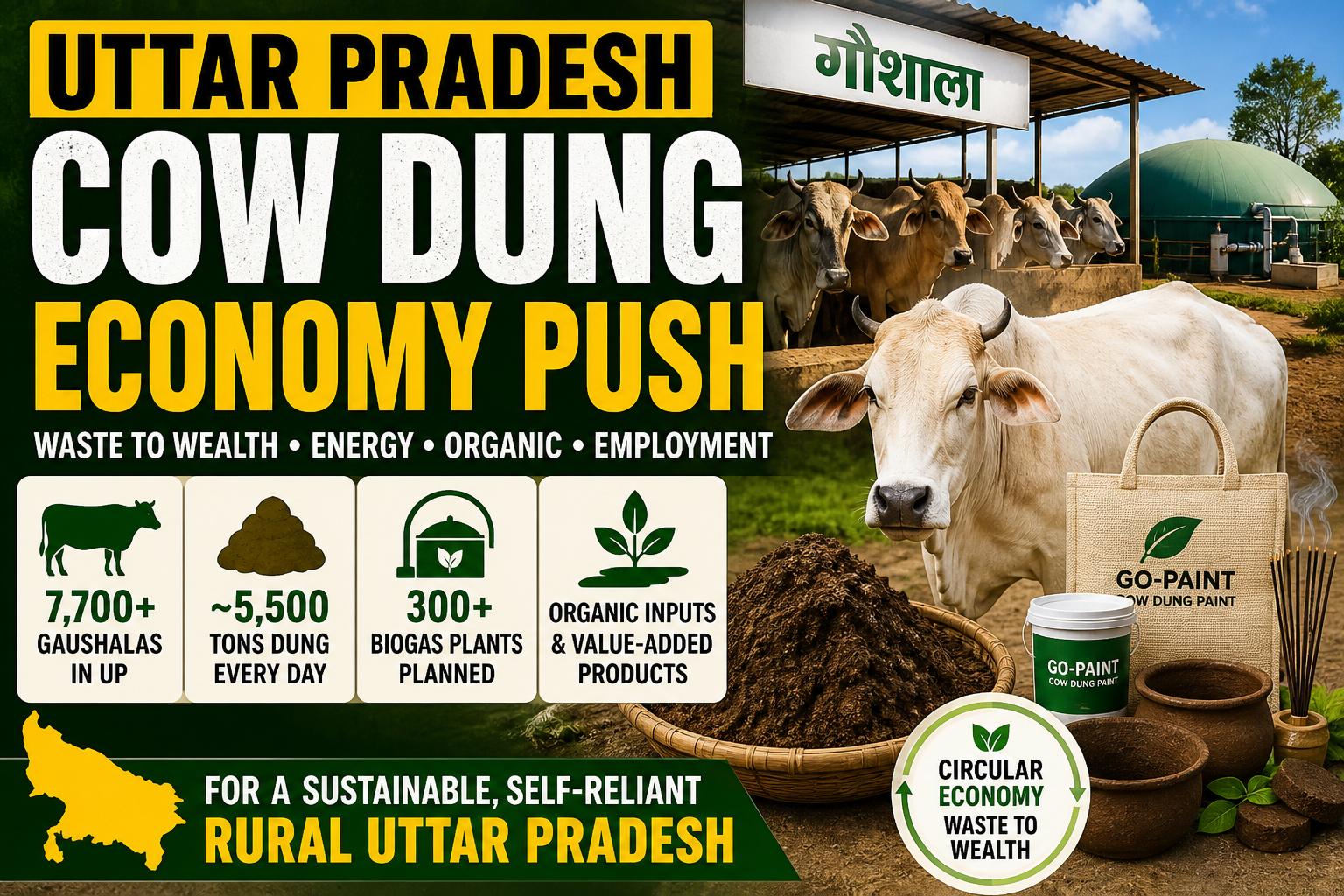
1. Key Facts
-
Latest Development (Date): May 5, 2026
Animal Husbandry Minister Dharampal Singh chaired a high-level meeting and directed preparation of a comprehensive action plan for statewide expansion. -
Objective:
Integrate animal husbandry with agriculture, make gaushalas self-reliant, increase farmer income, improve soil health, and promote waste-to-wealth model. -
Gaushalas in Uttar Pradesh:
~7,700 gaushalas (increased from ~100 in 2017)
Housing 11+ lakh cows -
Daily Cow Dung Availability:
~5,500 tons/day (≈ 54 lakh kg) -
Biogas Initiative:
-
Plan to install biogas plants in 300+ gaushalas
-
Outputs: Bio-CNG, electricity, organic manure
-
-
Natural Farming Expansion:
-
~94,000 hectares under cow-based natural farming
-
23,500 hectares in Bundelkhand (7 districts)
-
Additional expansion planned along the Ganga belt
-
₹2,500 crore allocation (2025–26)
-
-
Value-Added Products from Cow Dung:
-
Go-Paint (cow dung paint) for government buildings
-
Organic pots (polythene replacement)
-
Incense sticks
-
Vermicompost
-
Jeevamrit, Ghanjeevamrit, Panchgavya
-
Dung logs & bioplastics
-
-
Implementation Agencies:
-
Animal Husbandry Department
-
Agriculture Department
-
UP Gau Seva Aayog
-
Cooperatives, SHGs, NGOs
-
2. Components of the Initiative
(A) Energy & Fertilizer Production
-
Biogas plants for clean energy
-
Organic manure production from dung
(B) Sustainable Agriculture Inputs
-
Jeevamrit, Beejamrit
-
Promotion of Zero Budget Natural Farming (ZBNF)
(C) Livelihood Generation
-
Rural employment via gaushala-based units
-
Focus on women SHGs & rural youth
(D) Market Linkage System
-
Quality certification and standardization
-
Cooperative-based marketing
-
Government procurement (e.g., Go-Paint for offices)
3. Significance & Benefits
Economic Benefits
-
Increases farmer income
-
Reduces dependency on chemical inputs
-
Promotes rural entrepreneurship
-
Makes gaushalas financially self-sustainable
Agricultural Benefits
-
Improves soil fertility and organic carbon content
-
Reduces chemical fertilizer dependency
-
Promotes sustainable farming practices
Environmental Benefits
-
Methane capture → clean energy
-
Waste management improvement
-
Reduction in pollution and plastic usage
Social & Cultural Benefits
-
Strengthens cow protection-linked economic model
-
Promotes rural employment
-
Aligns with Atmanirbhar Bharat and circular economy
4. Analysis (Mains-Oriented)
Positive Aspects
-
Strong example of circular economy model
-
Converts waste (cow dung) into:
-
Energy
-
Fertilizer
-
Industrial products
-
-
Supports multiple SDGs:
-
Zero Hunger
-
Climate Action
-
Decent Work
-
Responsible Consumption
-
-
Supports doubling farmer income strategy
-
Culturally rooted yet economically modern
Challenges
-
Collection issue: Stray cattle dung management is difficult
-
Infrastructure cost: Biogas and processing units require high investment
-
Market limitation: Weak demand without strong awareness
-
Quality control: Standardization of products required
-
Scalability issue: Expansion across 75 districts needs coordination
Way Forward
-
Strengthen SHG + cooperative ecosystem
-
Integrate with national schemes (Biogas, Natural Farming Mission)
-
Invest in R&D for high-value products (bioplastics, bio-chemicals)
-
Improve digital marketing & branding of cow-based products
-
Expand skill development programs in rural areas
5. Exam Relevance
Prelims
-
Numbers (gaushalas, dung production, area under natural farming)
-
Schemes and initiatives
-
State-specific facts (UP)
Mains
-
Rural economy transformation
-
Sustainable agriculture
-
Livestock-based economy
-
Circular economy model
-
Environmental sustainability
Essay / Interview Topics
-
“Waste to Wealth Model in India”
-
“Cow-Based Economy and Rural Development”
-
“Sustainable Agriculture in India”
6. One-Liner Revision
👉 In May 2026, Uttar Pradesh advanced a cow dung economy model using 7,700+ gaushalas to convert ~5,500 tons/day of dung into biogas, organic inputs, and value-added products for promoting sustainable rural development and circular economy.