 Study Sarthi
11th Quad Foreign Ministers’ Meeting (May 2026)
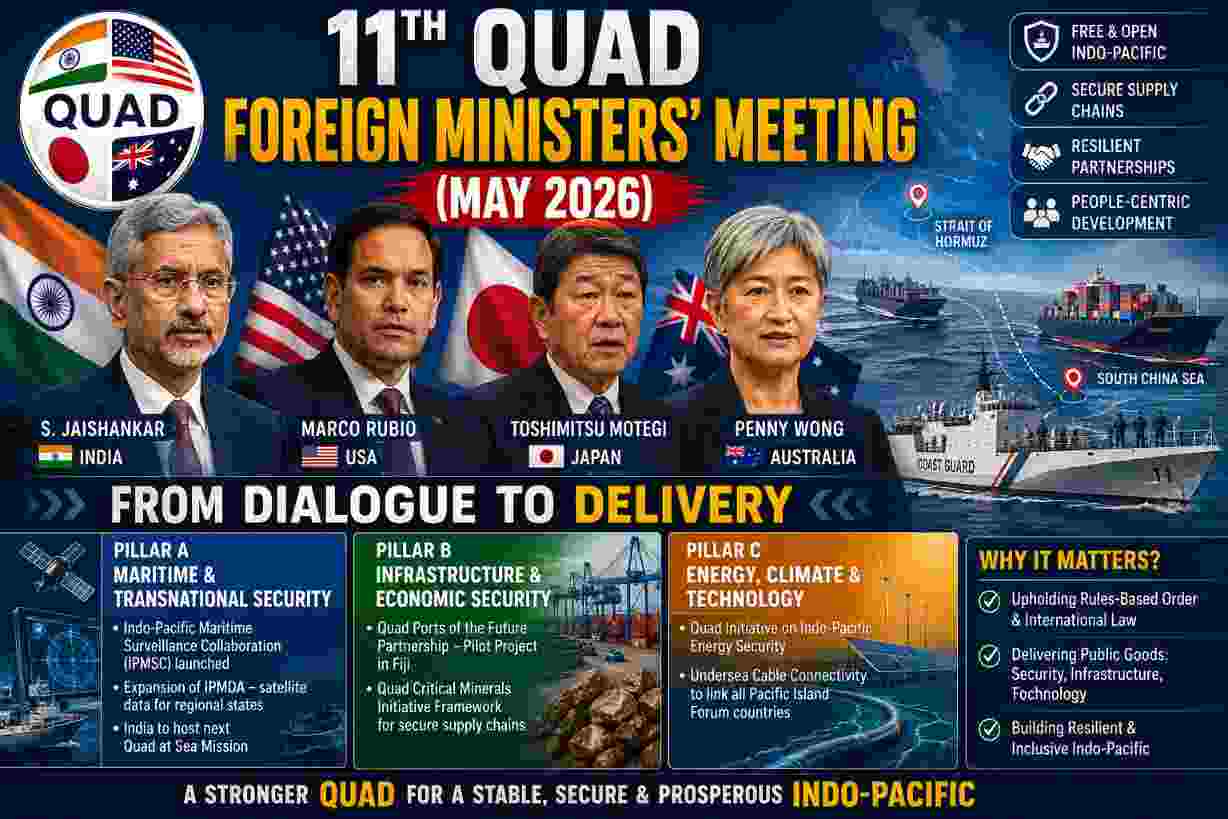
Syllabus Mapping: GS Paper II: International Relations (Bilateral, regional and global groupings involving India and/or affecting India's interests).
1. Core Context & Geopolitical Catalysts
The meeting transpired against a backdrop of escalating threats to global supply chains and international maritime law:
-
Persian Gulf & Strait of Hormuz: Heightened instability and non-state attacks on commercial shipping. Iran recently claimed the Strait of Hormuz is not an international waterway and stated it has no obligation to comply with the UNCLOS (UN Convention on the Law of the Sea).
-
South China Sea: Continuous unilateral, coercive, and grey-zone tactics challenging freedom of navigation.
2. Major Outcomes & Strategic Initiatives
The Quad framework shifted heavily from an abstract security dialogue toward tangible, delivery-oriented project execution across four primary pillars:
Pillar A: Maritime & Transnational Security
-
Indo-Pacific Maritime Surveillance Collaboration (IPMSC): A newly launched initiative designed to leverage and integrate the collective maritime surveillance assets of all four nations. Its primary focus is strengthening unclassified information sharing, starting initially with the Indian Ocean Region (IOR).
-
Expansion of IPMDA: The existing Indo-Pacific Partnership for Maritime Domain Awareness is being scaled up to provide near-real-time commercial satellite tracking data to smaller regional littoral states. This will help them counter illegal, unreported, and unregulated (IUU) fishing and maritime trafficking.
-
Quad at Sea Mission: India announced it will host the next iteration of this mission, physically bringing together the Coast Guards of all four nations onto a single vessel to normalize interoperability.
Pillar B: Infrastructure & Economic Security
-
Quad Ports of the Future Partnership: Launched to build resilient and high-capacity port systems. Australia announced its first pilot project under this banner to upgrade critical port infrastructure in Fiji (countering China's checkbook diplomacy in the Pacific Islands).
-
Quad Critical Minerals Initiative Framework: A strategic pact aimed at coordinating public-private investments, mining, processing, and recycling technologies to build secure supply chains independent of single-country dependencies (China).
Pillar C: Energy, Climate & Technology
-
Quad Initiative on Indo-Pacific Energy Security: A cooperative framework intended to safeguard regional energy markets and downstream supply chains (e.g., fertilizers) against global shockwaves.
-
Undersea Cable Connectivity: Reaffirmed commitments to map and deploy resilient digital infrastructure, aiming to connect all Pacific Island Forum countries via undersea data cables.
3. Analytical Breakdown (Mains Perspective)
Arguments for Strengthening the Quad (Pros)
-
Preserving Rules-Based Order: Directly challenges exceptionalist claims (like Iran's UNCLOS rejection or China’s Nine-Dash Line) by asserting freedom of navigation in global choke points.
-
Public Goods Provider: By focusing on satellite tracking data, disaster management (via the Indo-Pacific Logistics Network), and port upgrades in Fiji, the Quad presents itself as a constructive regional partner rather than an aggressive military alliance.
-
Securing India’s Strategic Autonomy: Allows India to deepen critical technological and military interoperability with major global powers without entering into a binding, formal mutual-defense treaty.
Key Challenges & Constraints
-
The "Militarization" Narrative: Groupings like China routinely criticize the Quad as an "exclusive bloc" or an Asian NATO aimed at containment. The MEA has to consistently defend that initiatives like IPMSC are non-military and public-centric.
-
Diverging National Priorities: The four members have varied degrees of economic coupling with China and distinct core strategic anxieties (e.g., India's continental border threat vs. Australia/Japan's maritime-centric focus).
-
Implementation Gaps: While Ministerial Meetings (FMM) are frequent, the delay in high-level Leaders' Summits occasionally stalls rapid geopolitical alignment.
4. Way Forward for India
-
Leverage for Domestic Capacity: India must utilize the Critical Minerals Framework and the Energy Security Initiative to secure its domestic manufacturing sector (Production Linked Incentive schemes) and ensure affordable energy transition for its population.
-
Maintain ASEAN Centrality: India must actively communicate and run collaborative exercises alongside ASEAN and the Indian Ocean Rim Association (IORA) to neutralize accusations of western-driven regional exclusion.
-
Enforce UNCLOS Interoperability: Use the upcoming Indian-hosted Quad at Sea Coast Guard mission to establish clear, standardized legal responses against non-state and state-sponsored disruptions at maritime choke points.
UPSC Mains Answer Writing Pointer: If asked about the changing nature of the Quad, highlight that the grouping is shifting from a "security-centric discussion club" to a "critical infrastructure, digital, and resource-sharing network" to offer tangible alternatives to regional countries.