Daily Current Affairs

Stay ahead with organized updates across various categories.

Clear
India Rejects Hague Arbitration Award on Indus Waters Treaty

India Rejects Hague Arbitration Award on Indus Waters Treaty

17 May 2026
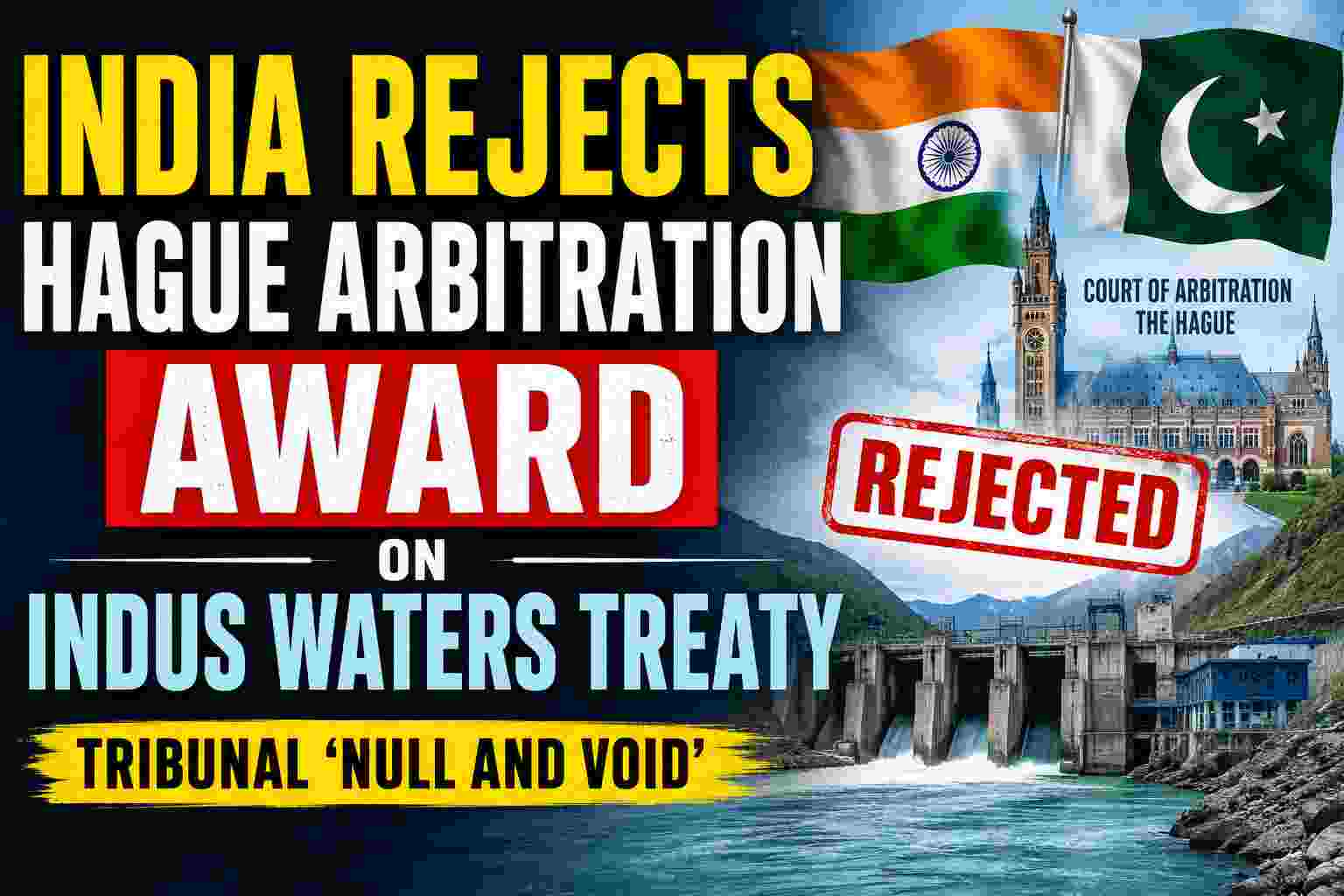
What happened? India has rejected a reported award issued by the Court of Arbitration (CoA) at The Hague regarding hydroelectric projects on the Indus river system. The dispute mainly concerns the Kishenganga and Ratle hydroelectric projects being built by India. India stated that it does not recognise the tribunal as legally constituted and therefore considers all its decisions “null and void.” Background: The Indus Waters Treaty The Indus Waters Treaty was signed in 1960 between India and Pakistan with the World Bank as a mediator. River Allocation India: Ravi, Beas, Sutlej (Eastern Rivers) Pakistan: Indus, Jhelum, Chenab (Western Rivers) India is allowed limited use of western rivers for: Hydropower generation Irrigation Non-consumptive purposes Why is Pakistan objecting? Pakistan challenged the design features of: Kishenganga Hydroelectric Project Ratle Hydroelectric Project The main issue is “pondage” — the amount of water that can be stored temporarily in run-of-river hydroelectric plants. Pakistan argues: India’s designs may allow excessive water control. This could affect downstream water flow into Pakistan. What is the Court of Arbitration (CoA)? The CoA is a five-member arbitration panel constituted in 2023 at Pakistan’s request. India refused to participate because: India believes the matter is technical, not legal. Under the treaty, technical disputes should first go to a Neutral Expert. A Neutral Expert process was already underway through the World Bank. India argues that running both mechanisms simultaneously violates the treaty framework. India’s Position External Affairs Ministry spokesperson Randhir Jaiswal said: The tribunal is “illegally constituted.” Any award issued is invalid. India’s decision to keep the treaty “in abeyance” remains effective. India has increasingly argued that: Pakistan repeatedly uses dispute mechanisms to delay Indian projects. The treaty needs modification due to changed geopolitical and security realities. What did the tribunal reportedly decide? According to reports: The tribunal interpreted treaty provisions largely in Pakistan’s favour. It reportedly restricted how India calculates permissible pondage. It narrowed India’s design flexibility for run-of-river projects. This could potentially limit operational freedom for future Indian hydropower projects. Why is this important? 1. India-Pakistan Relations Water-sharing is one of the few long-standing agreements that survived multiple wars and crises between the two countries. 2. Strategic Importance Hydroelectric projects in Jammu & Kashmir are strategically important for: Energy generation Regional development Water management 3. Treaty Interpretation Conflict The case highlights a deeper disagreement over: Who has jurisdiction? How disputes should be resolved? Whether treaty mechanisms can run simultaneously. Key Terms Pondage Temporary water storage used to regulate flow for hydropower generation. Run-of-River Project A hydropower plant that generates electricity without creating a large reservoir. Neutral Expert A technical specialist appointed under the treaty to resolve engineering/design disputes. Exam Relevance UPSC / State PCS Topics Covered: India-Pakistan relations International water treaties International arbitration Hydroelectric power Indus river system Possible Questions Discuss the significance of the Indus Waters Treaty in India-Pakistan relations. Why has India objected to the Court of Arbitration on the Indus dispute? Explain the concept of pondage in run-of-river hydropower projects.
India, UAE Seal Major Oil Storage and Defence Agreements

India, UAE Seal Major Oil Storage and Defence Agreements

16 May 2026
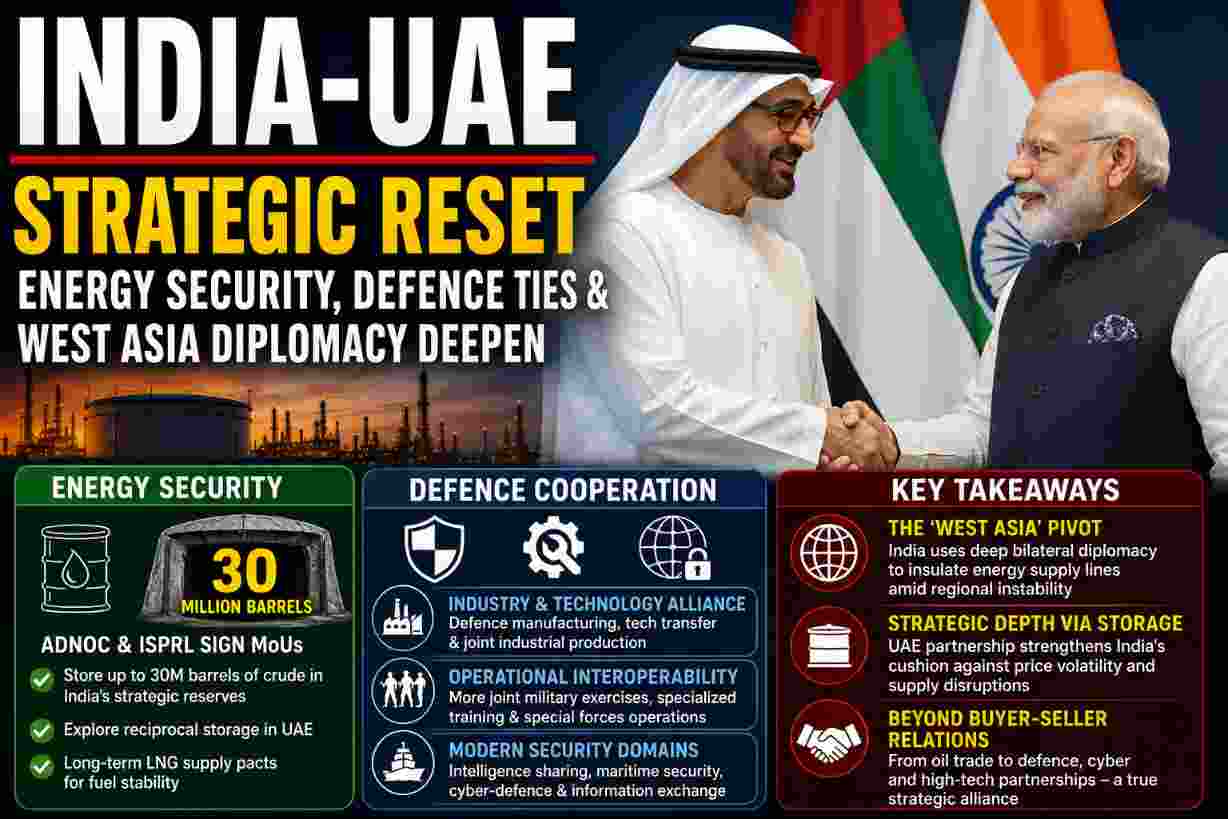
1. Event Overview Context: Prime Minister Narendra Modi’s state visit to the UAE (Abu Dhabi) as part of a 5-nation tour (including the Netherlands, Sweden, Norway, and Italy). Geopolitical Stance: India explicitly condemned recent regional attacks on the UAE, praising its "restraint" and offering support for regional peace efforts. 2. Key Pillar: Strategic Energy Security To fortify India's energy cushions against external shocks, the Abu Dhabi National Oil Company (ADNOC) and Indian Strategic Petroleum Reserves Ltd. (ISPRL) signed two major MoUs: Strategic Reserves: Agreement for storing up to 30 million barrels of crude oil in India's underground strategic reserves. Reciprocal Storage: Exploration of potential Indian crude oil storage facilities within the UAE. Supply Stability: Concluded pacts on long-term LNG (Liquefied Natural Gas) supplies to diversify India’s fuel basket. 3. Key Pillar: Strategic Defence Cooperation Framework An institutional framework proposed during January was officially concluded to upgrade the bilateral security relationship: Industrial & Tech Alliance: Deepened collaboration in defence manufacturing, technology transfer, and joint industrial production. Operational Interoperability: Increased scale of joint military exercises, specialized training, and special forces operations. Modern Security Domains: Enhanced intelligence sharing and coordination in maritime security, cyber-defence, and information exchange. 4. Key Analytical Takeaways The "West Asia" Pivot: Amid the broader West Asia crisis (which dragged down India's regional trade volumes in April 2026), these pacts show India actively using deep bilateral diplomacy to insulate its vital energy supply lines. Strategic Depth via Storage: Relying on the UAE to fill India's commercial and strategic petroleum reserves provides a cushion against price volatility and transit chokepoint disruptions. Beyond Buyer-Seller Relations: The shift from simple oil procurement to joint defence manufacturing and cyber-warfare capabilities marks a transition from a transactional relationship to a comprehensive strategic partnership.
India Back on EU Seafood Export List

India Back on EU Seafood Export List

15 May 2026
India has received a major boost in the seafood sector. The European Union (EU) has again allowed India to export aquaculture products like fish and shrimp to European countries from September 2026. Earlier, in 2024, the EU had removed India from its approved exporters list because of concerns related to the use of antibiotics and antimicrobials in food-producing animals. Now, India has proved that it follows EU safety rules. These rules do not allow harmful antimicrobial use for increasing animal growth or production. Aquaculture products include: Fish Shrimp and prawns Eels Fish products like caviar This decision is important because the EU is one of the biggest markets for Indian seafood exports. Why is this important? Good news for Indian seafood exporters Helps increase exports and income Creates more opportunities in fisheries sector Improves India’s image in global food safety standards Key Points India is back on the EU approved exporters list. Approval will apply from September 2026. India met EU rules on antimicrobial use. The EU is a major buyer of Indian seafood.
India Criticises Unilateral Sanctions at BRICS Meeting

India Criticises Unilateral Sanctions at BRICS Meeting

15 May 2026
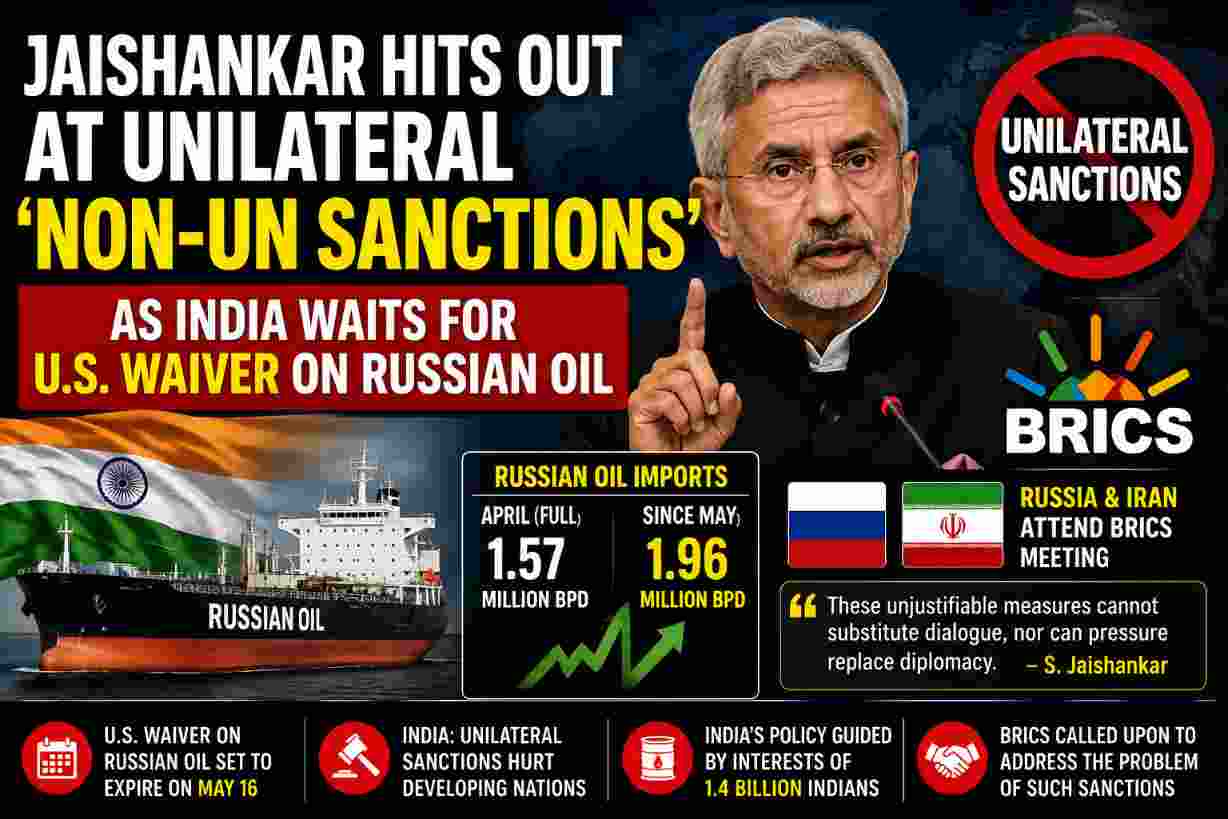
External Affairs Minister S. Jaishankar strongly criticised unilateral sanctions imposed by countries outside the United Nations framework during the BRICS Foreign Ministers’ Meeting held under India’s chairmanship. His remarks came as India awaits the decision of the United States on extending the waiver that allows India to continue importing Russian crude oil despite U.S. sanctions on Russia. Speaking at the BRICS meeting, Jaishankar said that sanctions not approved by the United Nations are “unjustified” and negatively affect developing countries. He stressed that dialogue and diplomacy are better solutions than pressure and coercive measures. The meeting was attended by Russian Foreign Minister Sergey Lavrov and Iranian Foreign Minister Abbas Araghchi, representing two countries heavily affected by U.S. sanctions. According to global shipping data, India’s imports of Russian oil increased sharply in May 2026. Indian refiners are buying more Russian oil because supplies from West Asia are facing disruptions due to tensions around the Strait of Hormuz. Reports suggest Russian oil imports reached around 1.96 million barrels per day in May, compared to 1.57 million barrels per day in April. The U.S. had earlier granted temporary waivers allowing countries like India to import oil from Russia and Iran due to the ongoing West Asia conflict. However, the waiver for Iran has already ended, and the Russian oil waiver is expected to expire soon. India has traditionally opposed unilateral sanctions that are not approved by the United Nations. At the same time, India also balances its foreign policy and energy needs carefully to protect national interests and ensure stable oil supplies for its large population. Why is this important? Highlights India’s independent foreign policy Shows the importance of energy security for India Reflects global tensions affecting oil markets Demonstrates BRICS cooperation on international issues Key Points India criticised non-UN sanctions at the BRICS meeting. S. Jaishankar called unilateral sanctions unjustified. India is waiting for the U.S. decision on the Russian oil waiver. Russian oil imports by India increased in May 2026. West Asia tensions are affecting global energy supplies.
Latvian Prime Minister Resigns Over Drone Controversy

Latvian Prime Minister Resigns Over Drone Controversy

15 May 2026
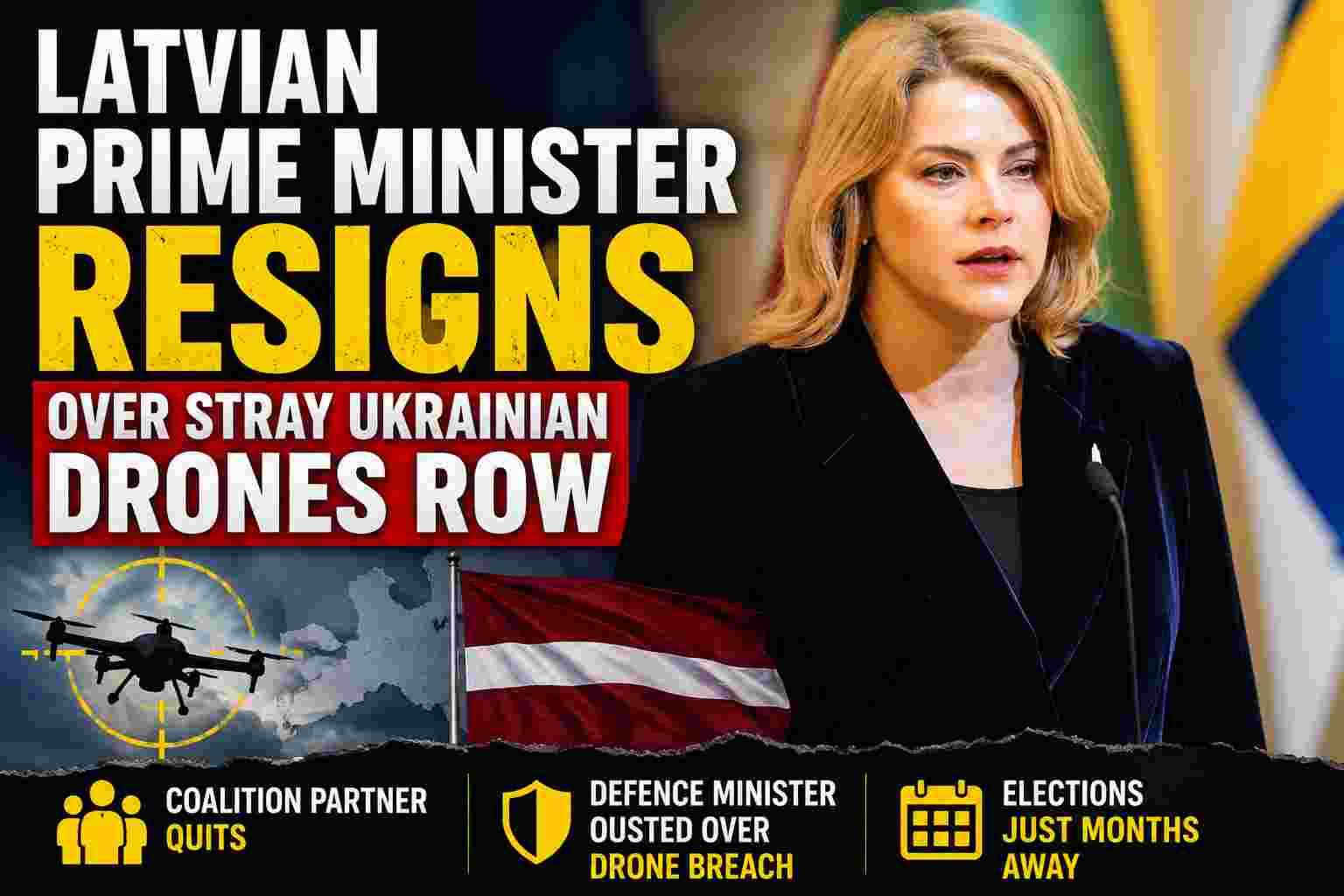
Evika Siliņa resigned as the Prime Minister of Latvia after her coalition government lost its majority in Parliament. The political crisis began when the left-leaning Progressives party withdrew support from the ruling coalition. This happened after Defence Minister Andris Sprūds was removed from his position following controversy over stray Ukrainian drones entering Latvian airspace. The drone incidents raised concerns about national security and border protection in Latvia, which shares regional security concerns because of the ongoing Russia-Ukraine conflict. Evika Siliņa’s resignation is significant because it comes only a few months before Latvia’s general elections. Political analysts believe the incident may affect public opinion and increase pressure on the next government to strengthen defence and security policies. Why is this important? Shows political instability in Latvia before elections Highlights security concerns linked to the Russia-Ukraine war Raises questions about airspace monitoring in European countries May influence Latvia’s future defence policies Key Points Latvian PM Evika Siliņa resigned. Coalition lost majority after partner party withdrew support. Defence Minister Andris Sprūds was removed over drone controversy. Ukrainian drones reportedly entered Latvian airspace. Resignation comes before Latvia’s general elections.
Iran’s Proposed Hormuz Protocol

Iran’s Proposed Hormuz Protocol

14 May 2026
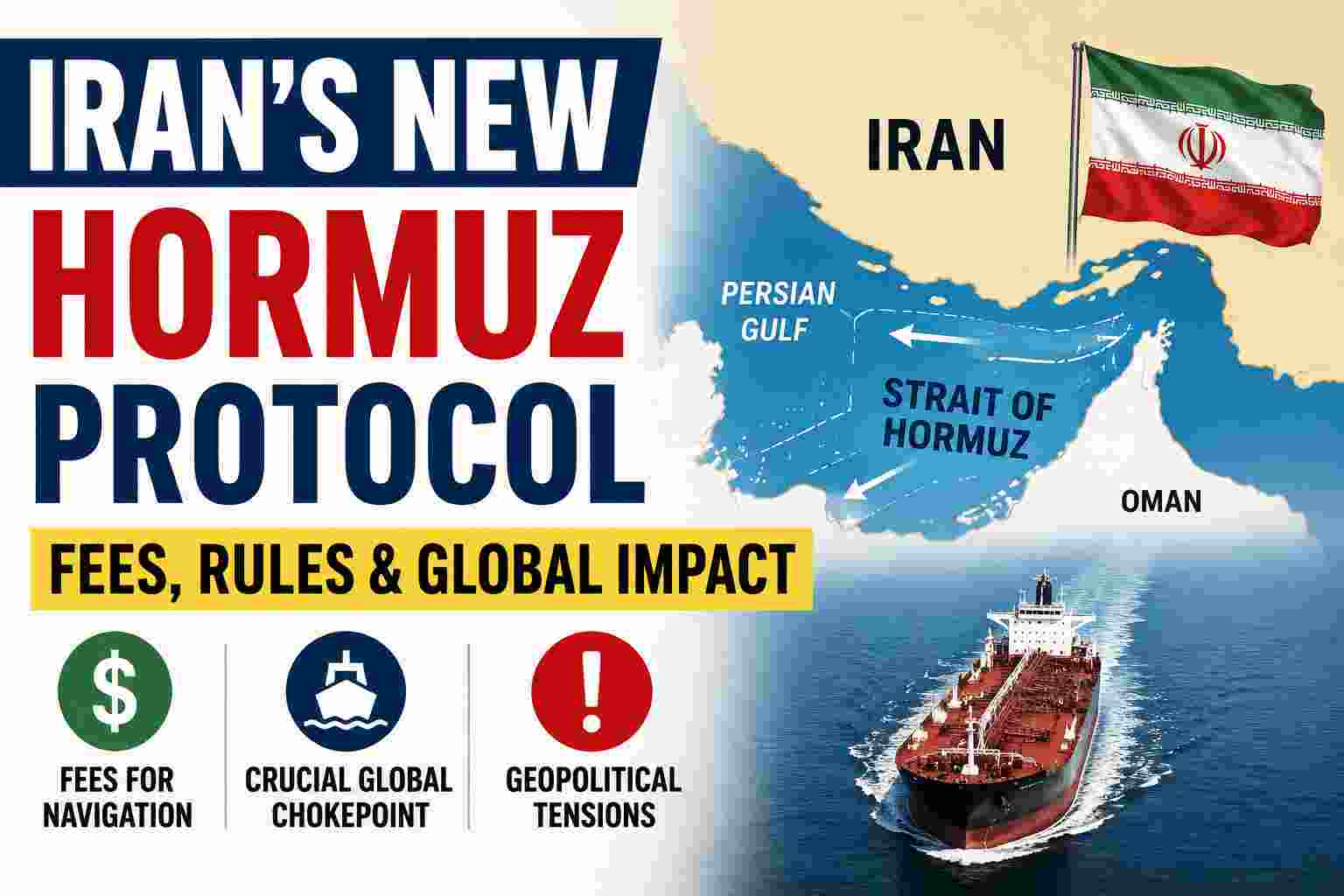
Iran is developing a new regulatory framework for the Strait of Hormuz, one of the world's most critical maritime chokepoints. This move has significant implications for global trade, energy security, and international maritime law. The "Hormuz Protocol" Explained For decades, Iran and Oman have provided navigation services in the Strait of Hormuz free of charge. Iran now plans to formalize these services through a new "protocol." Financial Component: The protocol aims to introduce fees to cover costs Iran incurs for ensuring safe navigation, managing maritime pollution, and conducting rescue operations. Legal Standing: Iran is not a member of the 1982 UN Convention on the Law of the Sea (UNCLOS). Because of this, Iranian officials argue they have the right to implement their own protocols over the chokepoint. Non-Discriminatory (With Exceptions): While Iran claims the arrangement will be non-discriminatory, it has explicitly stated it will not cooperate with countries found supporting the U.S. and Israel. Geopolitical Tensions The announcement comes amid heightened regional friction and diplomatic maneuvering: BRICS Friction: During a BRICS Foreign Ministers' meeting, Iran accused a "neighboring country" (alluding to the UAE) of trying to block a joint statement by attempting to include language condemning Iran's military strategy. U.S.-Israel Conflict: Iran accused the U.S. and Israel of initiating conflict on February 28, 2026, during nuclear negotiations. U.S. Rejection: U.S. President Donald Trump has already dismissed Iran's proposals, calling them "totally unacceptable." Impact on India and Global Shipping India’s Status: Iran has assured that the Strait will remain open to Indian-linked ships. Global Risk: Iranian officials warned that general marine traffic will be severely affected if the U.S. resumes military attacks on Iran. Key Terms for Students Term Definition in Context Strait of Hormuz A narrow waterway between the Persian Gulf and the Gulf of Oman; a vital route for global oil shipments. Chokepoint A strategic narrow passage that can be easily blocked to stop the flow of traffic. UNCLOS United Nations Convention on the Law of the Sea; an international agreement that establishes a legal framework for all marine and maritime activities. BRICS An intergovernmental organization comprising Brazil, Russia, India, China, South Africa, Egypt, Ethiopia, Iran, and the UAE.