 Study Sarthi
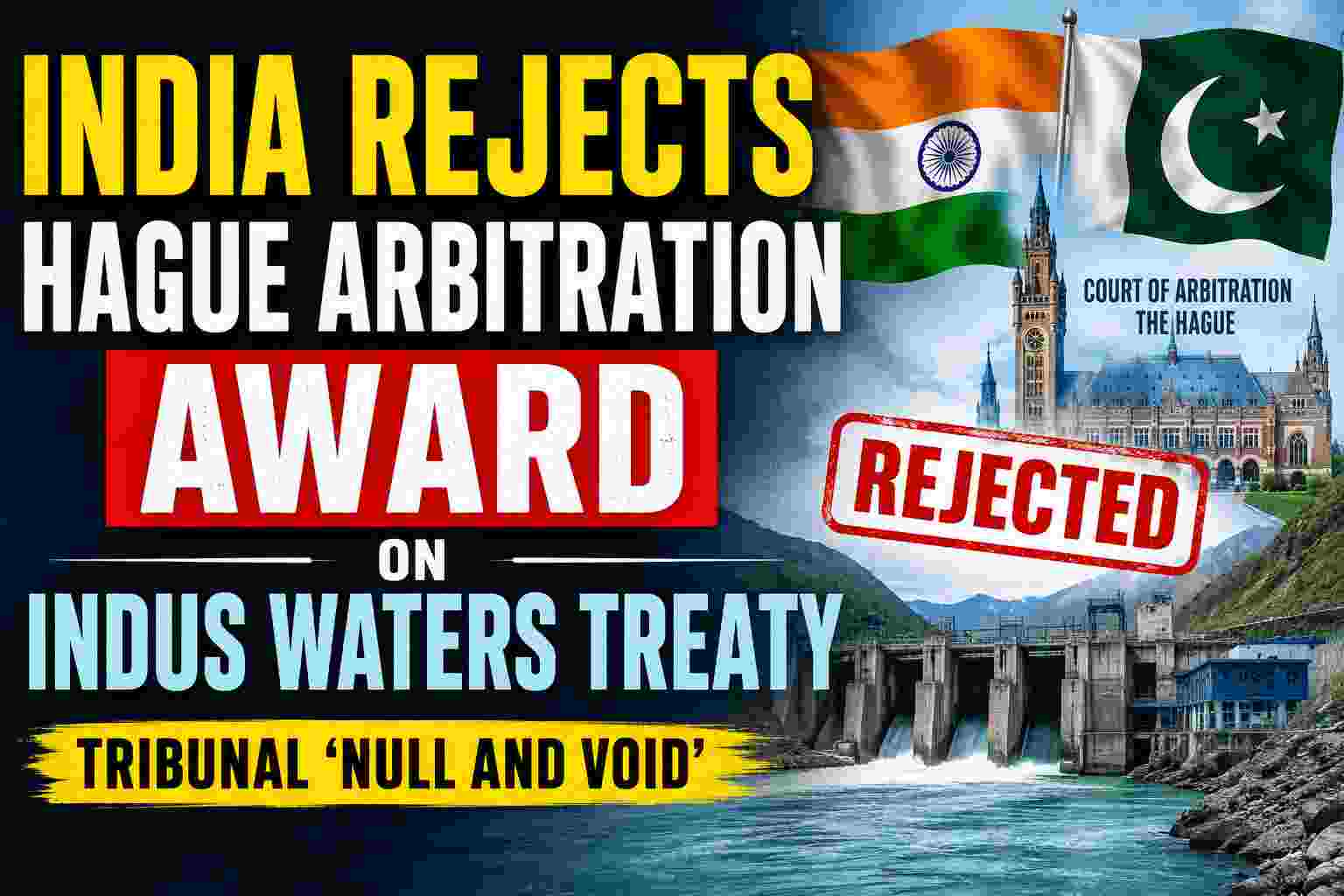
India Rejects Hague Arbitration Award on Indus Waters Treaty
What happened?
India has rejected a reported award issued by the Court of Arbitration (CoA) at The Hague regarding hydroelectric projects on the Indus river system. The dispute mainly concerns the Kishenganga and Ratle hydroelectric projects being built by India.
India stated that it does not recognise the tribunal as legally constituted and therefore considers all its decisions “null and void.”
Background: The Indus Waters Treaty
The Indus Waters Treaty was signed in 1960 between India and Pakistan with the World Bank as a mediator.
River Allocation
-
India: Ravi, Beas, Sutlej (Eastern Rivers)
-
Pakistan: Indus, Jhelum, Chenab (Western Rivers)
India is allowed limited use of western rivers for:
-
Hydropower generation
-
Irrigation
-
Non-consumptive purposes
Why is Pakistan objecting?
Pakistan challenged the design features of:
-
Kishenganga Hydroelectric Project
-
Ratle Hydroelectric Project
The main issue is “pondage” — the amount of water that can be stored temporarily in run-of-river hydroelectric plants.
Pakistan argues:
-
India’s designs may allow excessive water control.
-
This could affect downstream water flow into Pakistan.
What is the Court of Arbitration (CoA)?
The CoA is a five-member arbitration panel constituted in 2023 at Pakistan’s request.
India refused to participate because:
-
India believes the matter is technical, not legal.
-
Under the treaty, technical disputes should first go to a Neutral Expert.
-
A Neutral Expert process was already underway through the World Bank.
India argues that running both mechanisms simultaneously violates the treaty framework.
India’s Position
External Affairs Ministry spokesperson Randhir Jaiswal said:
-
The tribunal is “illegally constituted.”
-
Any award issued is invalid.
-
India’s decision to keep the treaty “in abeyance” remains effective.
India has increasingly argued that:
-
Pakistan repeatedly uses dispute mechanisms to delay Indian projects.
-
The treaty needs modification due to changed geopolitical and security realities.
What did the tribunal reportedly decide?
According to reports:
-
The tribunal interpreted treaty provisions largely in Pakistan’s favour.
-
It reportedly restricted how India calculates permissible pondage.
-
It narrowed India’s design flexibility for run-of-river projects.
This could potentially limit operational freedom for future Indian hydropower projects.
Why is this important?
1. India-Pakistan Relations
Water-sharing is one of the few long-standing agreements that survived multiple wars and crises between the two countries.
2. Strategic Importance
Hydroelectric projects in Jammu & Kashmir are strategically important for:
-
Energy generation
-
Regional development
-
Water management
3. Treaty Interpretation Conflict
The case highlights a deeper disagreement over:
-
Who has jurisdiction?
-
How disputes should be resolved?
-
Whether treaty mechanisms can run simultaneously.
Key Terms
Pondage
Temporary water storage used to regulate flow for hydropower generation.
Run-of-River Project
A hydropower plant that generates electricity without creating a large reservoir.
Neutral Expert
A technical specialist appointed under the treaty to resolve engineering/design disputes.
Exam Relevance
UPSC / State PCS
Topics Covered:
-
India-Pakistan relations
-
International water treaties
-
International arbitration
-
Hydroelectric power
-
Indus river system
Possible Questions
-
Discuss the significance of the Indus Waters Treaty in India-Pakistan relations.
-
Why has India objected to the Court of Arbitration on the Indus dispute?
-
Explain the concept of pondage in run-of-river hydropower projects.