16 May 2026
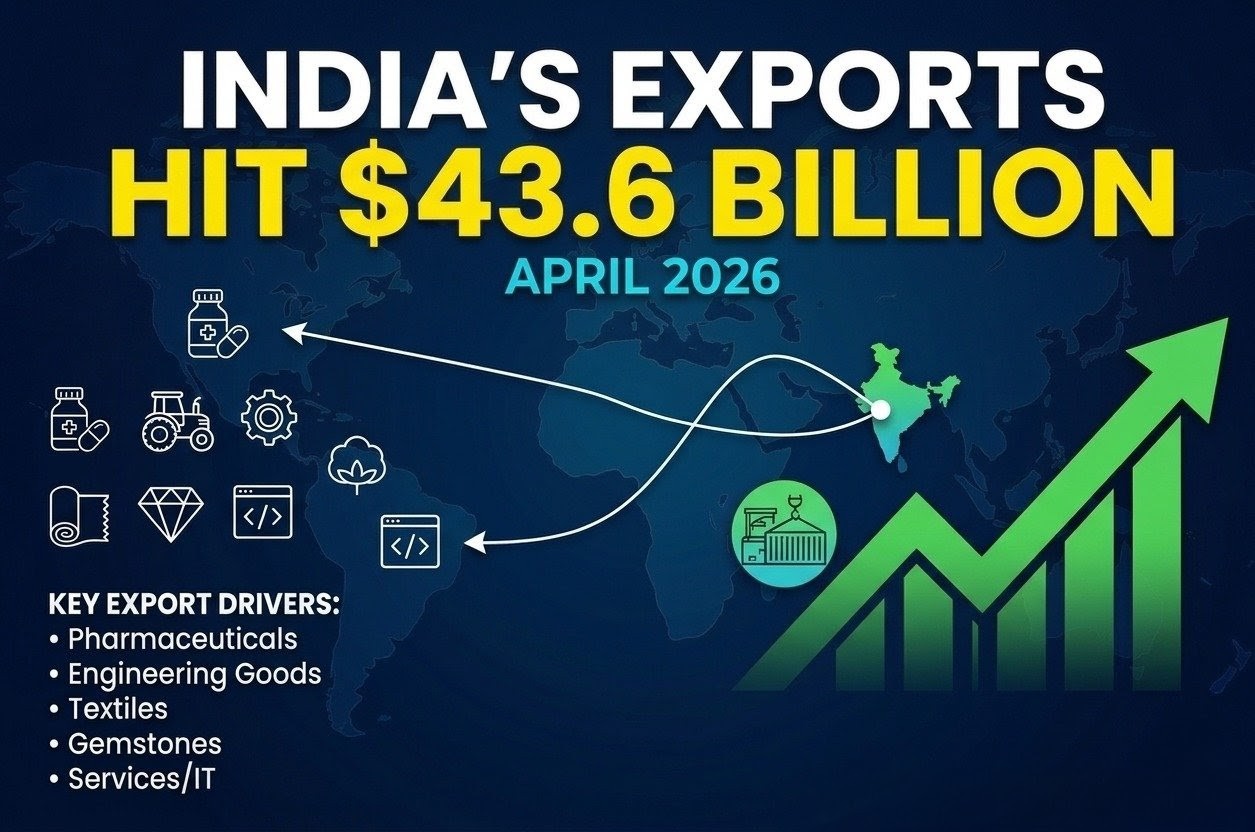
India’s April 2026 merchandise exports grew 14% to $43.6B. Driven by market diversification and strong services, the overall trade deficit fell 30% to $7.8B.
Trade Performance
1. Data
Merchandise Trade: Exports grew ~14% to $43.6 billion (vs $38.3B in April 2025); Imports rose to $71.9 billion.
Services Trade: Exports jumped to $37.2 billion; Imports marginally dipped to $16.7 billion.
Net Deficit: The overall trade deficit (Goods + Services) shrank by 30% to $7.8 billion, thanks to a strong services surplus cushioning the goods deficit.
2. Core Trends & Drivers
Price Effect: Rising global commodity prices artificially boosted the nominal value of exports.
Supply Resilience: Industry successfully maintained domestic supply chains despite global maritime bottlenecks.
Market Diversification: Exporters hedged risks by shifting focus to non-traditional and historically smaller destinations.
3. Shift in Export Destinations
India recorded massive growth spikes in alternate markets to counter traditional slowdowns:
Asia-Pacific & Neighborhood: Sri Lanka (+215%), Singapore (+179%), Bangladesh (+64%), and Vietnam (+53%).
Africa: Exports to Tanzania surged 158% to reach $1.2 billion.
4. Geopolitical Shock: West Asia Crisis
Regional conflict heavily depressed trade volumes along traditional Middle Eastern/Red Sea routes:
Exports to West Asia: Dropped 28% to $4.16 billion.
Imports from West Asia: Fell 31.6% to $10.5 billion (reflecting lower/disrupted energy and raw material inflows).
5. Key Takeaways
Services as a Macro Buffer: The widening gap in merchandise trade is systematically absorbed by India's structural strength in service exports, keeping the overall external balance stable.
Volume vs. Value: Growth driven by global price inflation is a temporary cushion. Long-term export stability requires scaling up real cargo volumes, lowering logistics overheads, and expediting bilateral trade pacts.
Transit Vulnerabilities: The sharp drop in West Asian trade underlines India's extreme exposure to strategic maritime chokepoints, stressing the urgency for viable, multi-modal transport corridors.
 Study Sarthi