05 May 2026
1. Key Facts
Latest Development (Date): May 5, 2026Animal Husbandry Minister Dharampal Singh chaired a high-level meeting and directed preparation of a comprehensive action plan for statewide expansion.
Objective:Integrate animal husbandry with agriculture, make gaushalas self-reliant, increase farmer income, improve soil health, and promote waste-to-wealth model.
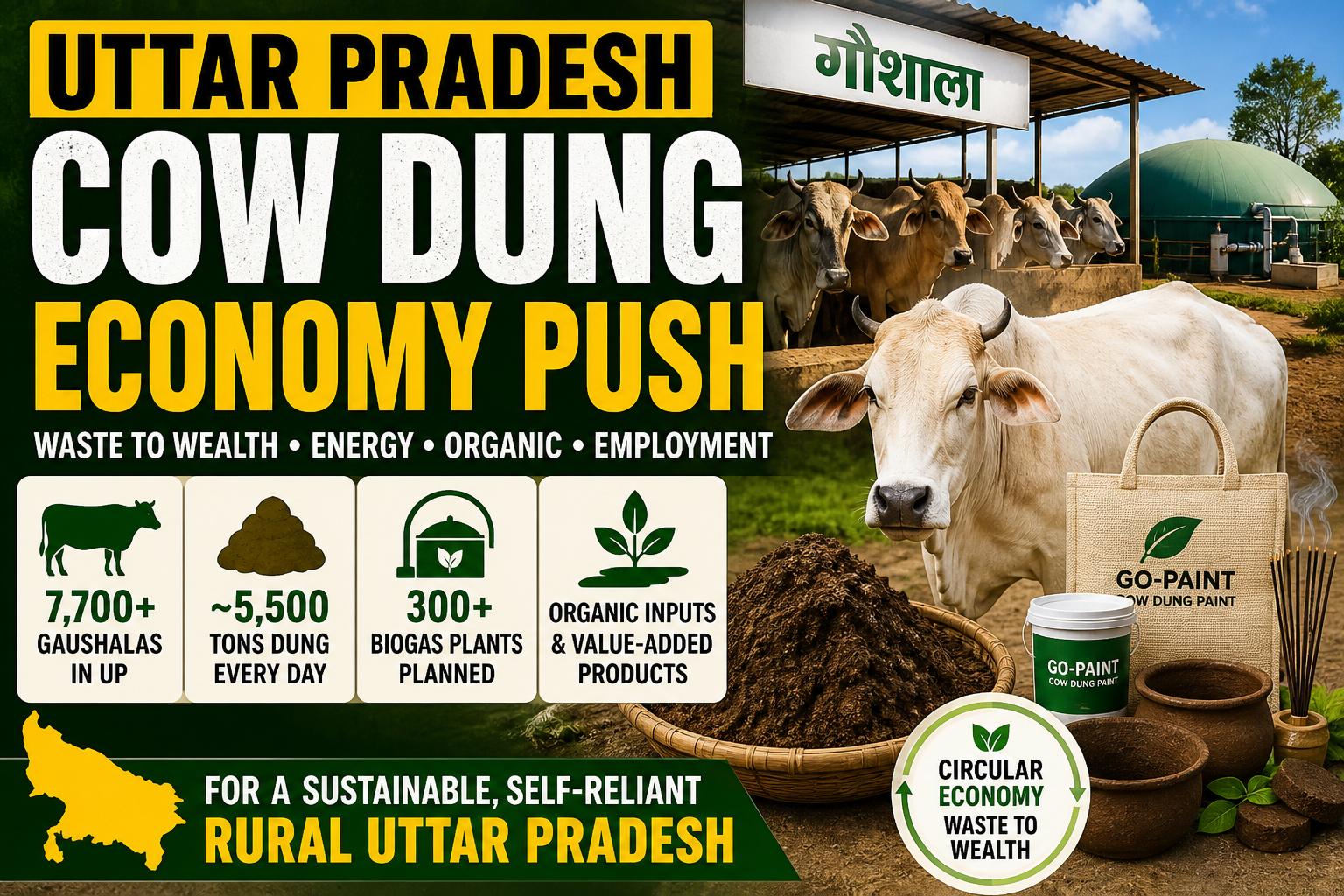
Gaushalas in Uttar Pradesh:~7,700 gaushalas (increased from ~100 in 2017)Housing 11+ lakh cows
Daily Cow Dung Availability:~5,500 tons/day (≈ 54 lakh kg)
Biogas Initiative:
Plan to install biogas plants in 300+ gaushalas
Outputs: Bio-CNG, electricity, organic manure
Natural Farming Expansion:
~94,000 hectares under cow-based natural farming
23,500 hectares in Bundelkhand (7 districts)
Additional expansion planned along the Ganga belt
₹2,500 crore allocation (2025–26)
Value-Added Products from Cow Dung:
Go-Paint (cow dung paint) for government buildings
Organic pots (polythene replacement)
Incense sticks
Vermicompost
Jeevamrit, Ghanjeevamrit, Panchgavya
Dung logs & bioplastics
Implementation Agencies:
Animal Husbandry Department
Agriculture Department
UP Gau Seva Aayog
Cooperatives, SHGs, NGOs
2. Components of the Initiative
(A) Energy & Fertilizer Production
Biogas plants for clean energy
Organic manure production from dung
(B) Sustainable Agriculture Inputs
Jeevamrit, Beejamrit
Promotion of Zero Budget Natural Farming (ZBNF)
(C) Livelihood Generation
Rural employment via gaushala-based units
Focus on women SHGs & rural youth
(D) Market Linkage System
Quality certification and standardization
Cooperative-based marketing
Government procurement (e.g., Go-Paint for offices)
3. Significance & Benefits
Economic Benefits
Increases farmer income
Reduces dependency on chemical inputs
Promotes rural entrepreneurship
Makes gaushalas financially self-sustainable
Agricultural Benefits
Improves soil fertility and organic carbon content
Reduces chemical fertilizer dependency
Promotes sustainable farming practices
Environmental Benefits
Methane capture → clean energy
Waste management improvement
Reduction in pollution and plastic usage
Social & Cultural Benefits
Strengthens cow protection-linked economic model
Promotes rural employment
Aligns with Atmanirbhar Bharat and circular economy
4. Analysis (Mains-Oriented)
Positive Aspects
Strong example of circular economy model
Converts waste (cow dung) into:
Energy
Fertilizer
Industrial products
Supports multiple SDGs:
Zero Hunger
Climate Action
Decent Work
Responsible Consumption
Supports doubling farmer income strategy
Culturally rooted yet economically modern
Challenges
Collection issue: Stray cattle dung management is difficult
Infrastructure cost: Biogas and processing units require high investment
Market limitation: Weak demand without strong awareness
Quality control: Standardization of products required
Scalability issue: Expansion across 75 districts needs coordination
Way Forward
Strengthen SHG + cooperative ecosystem
Integrate with national schemes (Biogas, Natural Farming Mission)
Invest in R&D for high-value products (bioplastics, bio-chemicals)
Improve digital marketing & branding of cow-based products
Expand skill development programs in rural areas
5. Exam Relevance
Prelims
Numbers (gaushalas, dung production, area under natural farming)
Schemes and initiatives
State-specific facts (UP)
Mains
Rural economy transformation
Sustainable agriculture
Livestock-based economy
Circular economy model
Environmental sustainability
Essay / Interview Topics
“Waste to Wealth Model in India”
“Cow-Based Economy and Rural Development”
“Sustainable Agriculture in India”
6. One-Liner Revision
👉 In May 2026, Uttar Pradesh advanced a cow dung economy model using 7,700+ gaushalas to convert ~5,500 tons/day of dung into biogas, organic inputs, and value-added products for promoting sustainable rural development and circular economy.
 Study Sarthi