16 May 2026
1. Context
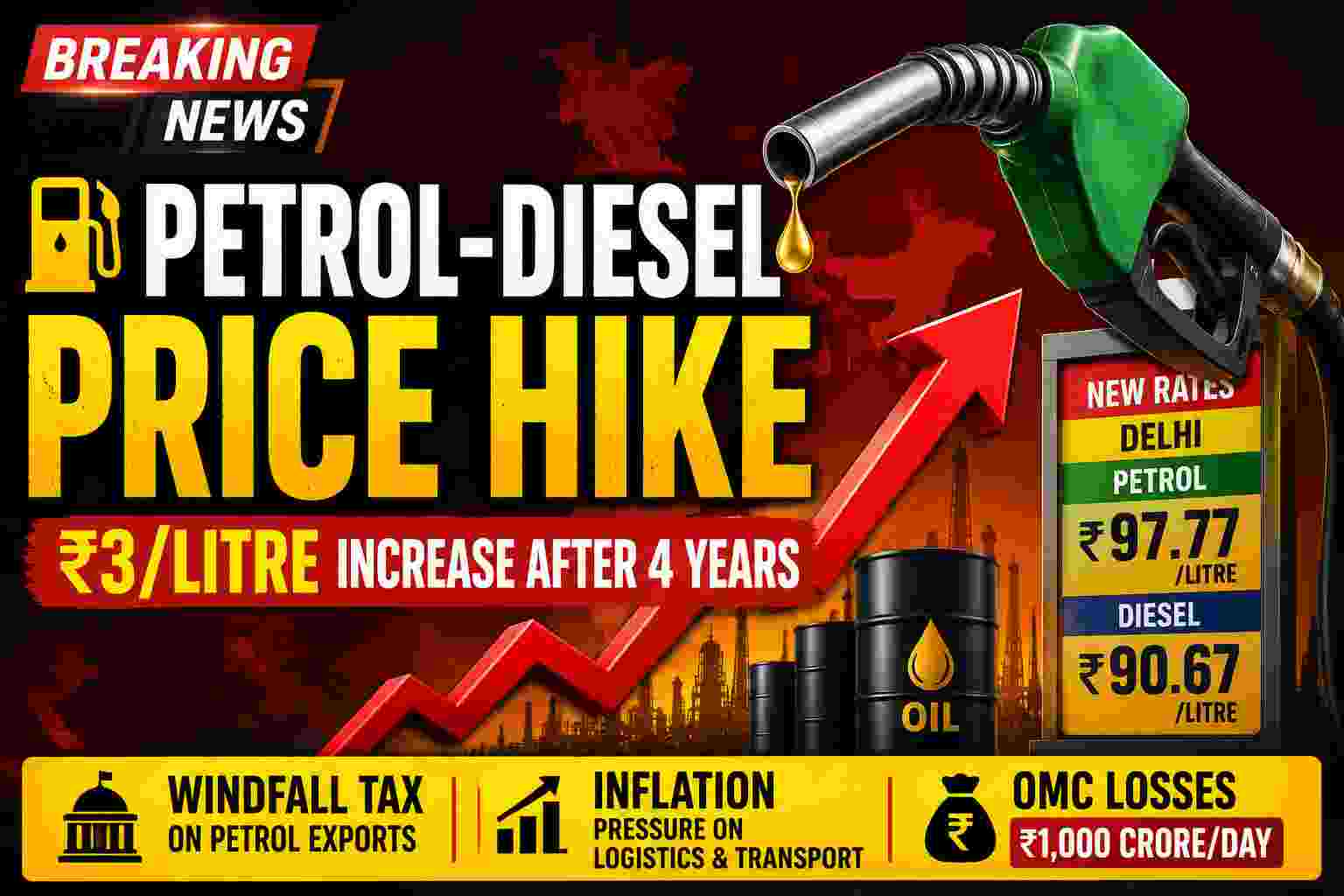
Retail Hikes: Petrol and diesel prices hiked by ₹3 per litre across all variants. Compressed Natural Gas (CNG) prices increased by ₹2 per kg.
Historical Context: This marks the first major retail fuel price hike (defined as >₹1/litre) in over four years, since the staggered ₹9 hike following the March 2022 Russia-Ukraine conflict.
New Base Rates (Delhi): * Regular Petrol: ₹97.77 / litre
Regular Diesel: ₹90.67 / litre
2. Fiscal Measures: Windfall Tax Adjustments
Simultaneously, the Central Government restructured the windfall gains tax regime to regulate outbound shipments and domestic availability:
Petrol Exports: New windfall tax of ₹3 per litre imposed.
Diesel Exports: Levy reduced to ₹16.5 per litre.
Aviation Turbine Fuel (ATF): Levy reduced to ₹16 per litre.
3. Under-Recoveries & OMC Financial Strain
The Macro Loss: Prior to this decision, State-run Oil Marketing Companies (OMCs like IOCL, BPCL, HPCL) were bearing combined losses of approximately ₹1,000 crore per day across petrol, diesel, and LPG.
Global Catalysts: Severe upstream financial pressure caused by global crude oil spikes, soaring freight rates, and supply-chain re-routing born out of the ongoing conflict in West Asia.
The Fiscal Gap: Structural under-recoveries stood at ₹13–15/litre for petrol and ₹17–18/litre for diesel. Experts note the ₹3 hike is only a partial buffer; a ₹10 per litre hike is required to bridge even 50% of the OMCs' true under-recoveries.
4. Strategic Multi-Dimensional Impact
Consumer Inflation Risks: While a ₹3 hike offers a breather to corporate OMC balance sheets, it introduces cascading input-cost pressures across logistics, public transport, and agricultural supply chains.
Demand-Side Management: Aligns with the political executive’s recent public push urging citizens to voluntarily curb fuel consumption to ease India's high crude import bill.
The "Export vs Domestic" Balance: Imposing a windfall tax on petrol exports acts as a regulatory disincentive for domestic refiners private or public to prioritize lucrative international markets over domestic fuel pumps during a global energy crunch.
What is Windfall Tax?
A windfall tax is a higher, temporary tax levied by a government on specific companies or industries that have experienced sudden, exceptionally high, and unexpected profits.
These extraordinary gains are called "windfalls" because they do not result from any strategic investment, expansion, or sudden business innovation by the company itself. Instead, they are entirely driven by external economic shocks or geopolitical events beyond the company's control.
1. Why Do Governments Impose It?
Redistributing Excess Wealth: It ensures that companies profiting massively from a crisis contribute a fair portion back to the economy, rather than keeping all the gains.
Funding Public Relief: The extra revenue generated is often channeled directly into funding public welfare programs, infrastructure development, or consumer subsidies to ease the burden of the crisis on the general public.
Fiscal Balancing: It provides governments with emergency revenue during times of crisis (such as wars or high import bills) without having to raise regular taxes on ordinary citizens.
 Study Sarthi